KFM and Electroscopes
The K.F.M - What IS it ?
The Kearny Fallout Meter, that's what it is, most often abbreviated to K.F.M. or just plain KFM.
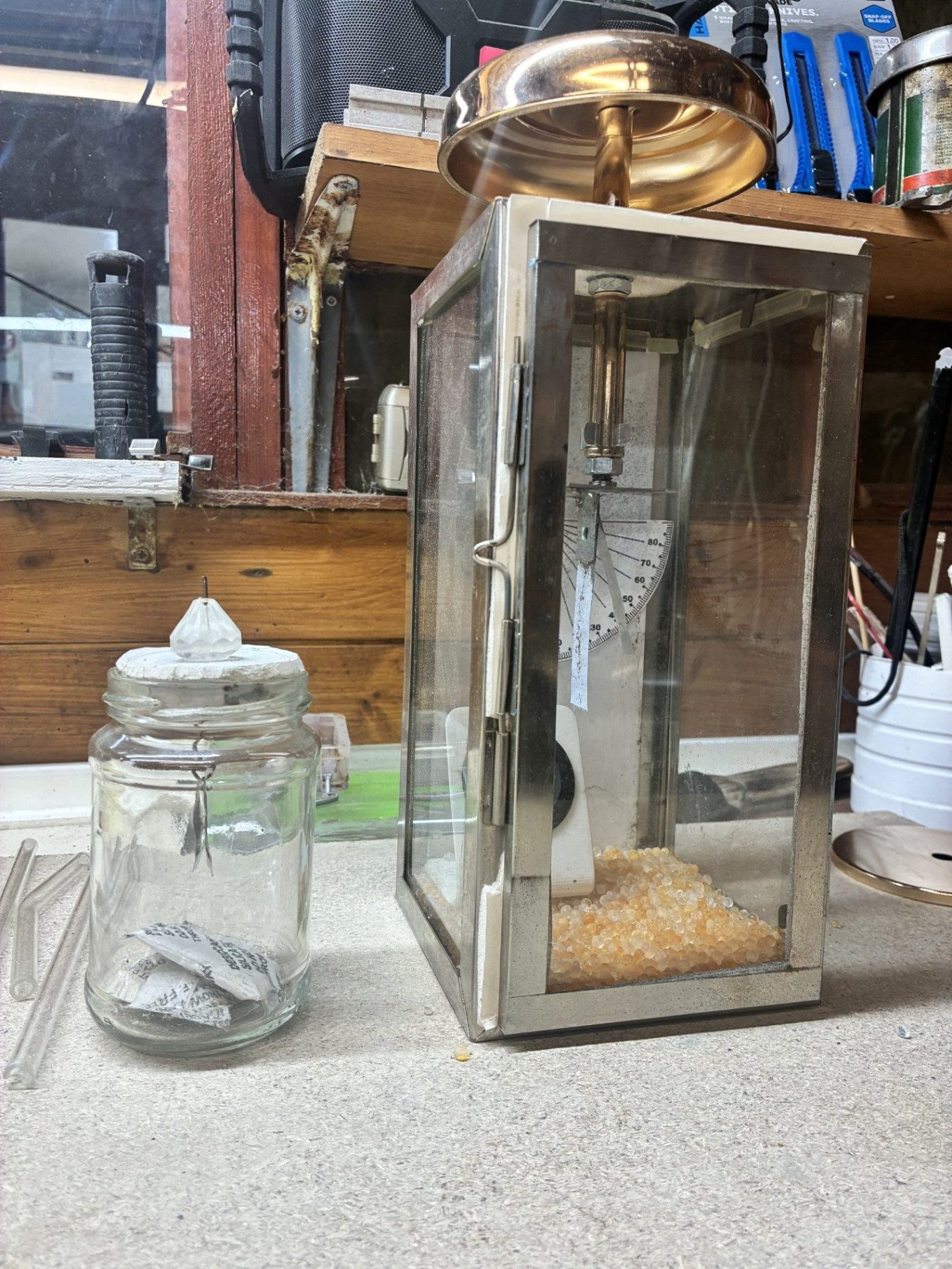
The photograph below shows TWO devices which the KFM owes at least SOME of its elelments to.
The jar on the left is a school science class electroscope, loved by science teachers everywhere due to its simplicity and ease of construction which allows the kids to make it themselves and then experiment with it. Ideal case of Learning-By-Doing
The device on the right is similar, but has a measuring scale, which makes it an Electrometer, since it can meter, or MEASURE the deflection of the metal leaf.
The Kearny Fallout Meter or K.F.M. is a TWO leaf instrument, carefully designed to minimise leakage from all sources other than ionising radiation. The only likely source of ionising radiation when the K.F.M. has been charged and the charging wire lifted away from the leaves is gamma radiation - Clever !
For precise details on how to make your own KFM, follow the instructions in the book "Nuclear War Survival Skills"
Cold War 1 Prepping at its most ingenious
The idea of using an electroscope as a gamma radiation fluxmeter for home civil defence dates back to 1960 where at a conference a presentation was made by Callaghan and Kaplan regarding how a simple electroscope could be used as a home radiation meter.
While earlier civil‑defense electroscope designs, such as the 1960 Callahan–Kaplan
home‑built instrument, demonstrated the feasibility of household construction
they suffered from limited sensitivity, unstable charge retention, and difficult assembly. These limitations prevented their adoption for large‑scale
civil defense use.
The Kearny Fallout Meter (1973) addressed these deficiencies
through improved leaf geometry, triboelectric charging, and a reproducible
calibration method based on timed discharge.
Cresson Kearny was convinced that with some fairly simple expedient measures, millions of American lives could be save if the unthinkable happened and a Nuclear exchange took place .
Because of the long fallout plumes which would occur if the Minuteman missile sites were "dug out" with Soviet nuclear weapons , he thought it might be useful if American households had the ability to build a fallout meter themselves.
There are MANY websites dedicated to this instrument , and some very good videos too.
Electroscopes have a long and honourable History
The electroscope at its most basic is simply a pair of metal leaves which will repel each other when electrostatically charged.
Various early pioneers came up with their own designs of Electrometer - a device capable of quantifying the measurement.
The various anomalies they found, with the Electroscope charge behaving in ways they did NOT anticipate ultimately led to quantum Theory and eventually Quantum Mechanics.
One of the anomalies was that ordinary light would not decay the charge on an electrometer/electroscope, but high Ultra Violet and further up the electromagnetic spectrum would, evein if not as "bright".
Max Planck proposed a solution to what was known as "The Ultraviolet Catastrophe" in 1900, later confirmed by Albert Einstein and the duality of wave/packet electromagnetic waves was confirmed.
Since then and after many refinements , the at one time considered outrageous , Quantum Mechanics was developed, a complex mathematical convention which allows predictions of behaviour to be made with astonishing accuracy.
And all this started with a scientific instrument which schoolchildren can happily reproduce with a jam jar, some kitchen foil , a piece of wire and some Blu Tak.
KFM and charging etc
Don't worry , the Kearny Fallout Meter has been studied every which way.
There are many observations on the KFM, but the most authorative, and , I believe the best, is this one. Written in the form of a scientific thesis, J.T. McDonald is now an expert in the field of Nuclear Medicine and co-authored this as a Doctorate Student.
McDonald JT, West WG, Kearfott KJ. An evaluation of the Kearny Fallout Meter (KFM), a radiation detector constructed from commonly available household materials. Health Phys. 2004 Nov;87(5 Suppl):S52-7. doi: 10.1097/00004032-200411002-00006. PMID: 15551780.
Well worth reading, the hands on and practical observations are of tremendous value and explain a lot of the difficulties other people experience with the production, charging and use of the KFM.
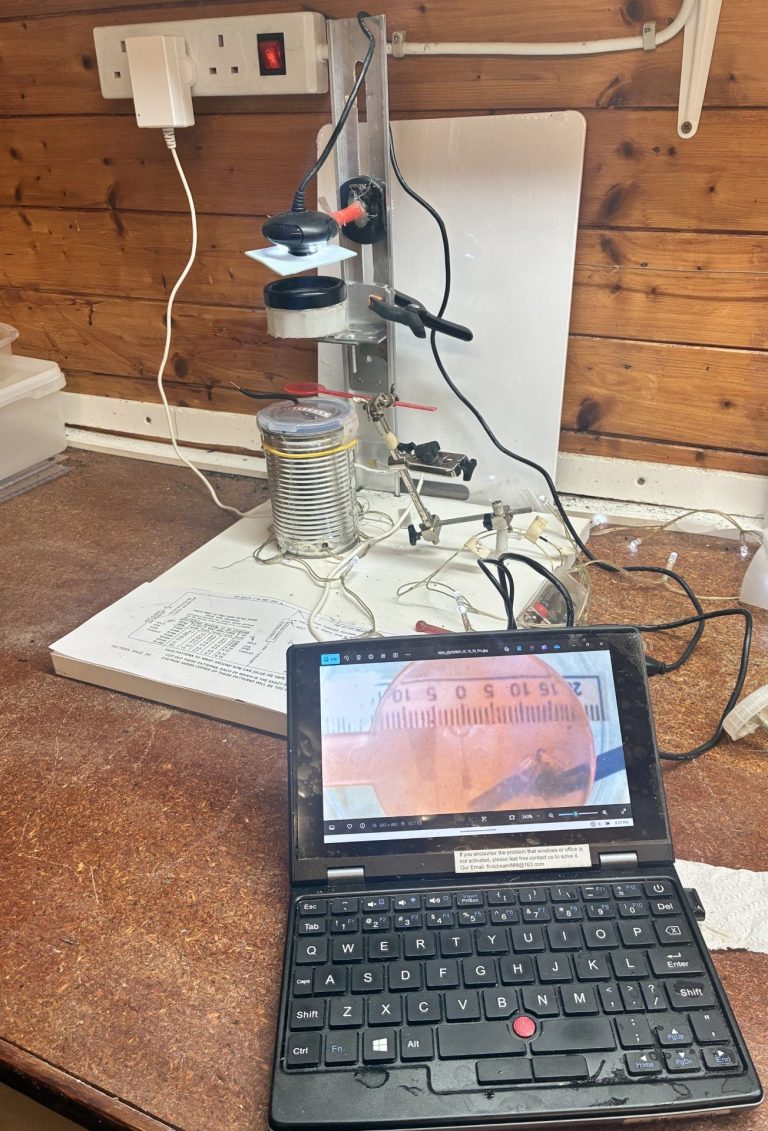
The photograph on the right is my own test rig and the observant will notice immediately that it is NOT a KFM. The can volume and proportions are not as specified. Since the KFM is actually dependent on several critical properties, including leaf mass, centre of gravity , area as expected for ANY electroscope but also the capacitor charge volume/area of the can , for my test rig the transfer from rate of change of leaf divergence to radiation dose rate is lost.
Not a problem for the purpose of the test rig which was simply to investigate the problems encountered by McDonald et al.
Specifically ;
Inability to achieve satisfactory charging and adequate leaf divergence.
Inability to achieve the minimum non-fallout condition decay in leaf divergence for the minimum specified time - the only "calibration" possible and the only gauge of performance given by Kearny himself.
Other difficulties , not specifically mentioned by McDonald et al were:
My inability to determine the position of the LOWER edge of the leaves, due to bad light or reflected glare from the type of light source which would almost certainly be used in the situation which a KFM would be of use (a hand torch). I found the reflected glare and internal reflection from the metallic surfaces of the can made it difficult, even with no other light sources present.
Hence the use of the non-Kearny test rig. First of all, in common with other optical instruments, I thought backlighting would be more effective in determining the leaf position. This technique is used in many instruments , from refractometers to shadowgraphs and even some precision laboratory weighing scales.
The back illumination was provided by an LED array powered by 2 AAA batteries with switch. Total cost $2.
White LEDs were used and I found that this time the back glare made viewing the leaf position difficult. This was solved by "burying" the LED's in the orange bead silica gel desiccant, eliminating glare and producing a colour contrast orange backlight "Glow"
Okay , so a K.F.M. works but what purpose would it serve ?
Hint : What if you don't know what to with the readings ??????
Historical Context: Why Expedient Shelters and the KFM Were Mocked
From the late Cold War onward, expedient civil‑defence measures—especially homemade fallout meters and improvised shelters—became easy targets for satire. Popular culture painted them as symbols of futility: cardboard‑and‑string gadgets against nuclear fire, or “dig a hole and pray” shelters that supposedly offered no real protection. Much of this mockery came from a misunderstanding of what these tools were actually designed to do.
Home Civil Defence measures were never about surviving a direct nuclear strike. they were about surviving fallout and a period when all normal services were disrupted., which is a different and far more survivable hazard.
Expedient shelters were engineered to provide meaningful protection against radiation, and the Kearny Fallout Meter was created to give ordinary people the one thing they would otherwise lack entirely: local, real‑time dose‑rate information. In the absence of official guidance, that information is the difference between blind panic and rational decision‑making.
The ridicule stuck, not because the tools were useless, but because their purpose was rarely explained clearly. What follows is the part that was missing from the public conversation: how a simple, homemade instrument can guide life‑saving decisions when nothing else is available.How it works is explained elsewhere , but in order to get the thing to work it has to be charged first.
- This requires a "charging kit" and an operator who knows how to use it and then to interpret the data produced.
- The resultant data is in the form of a reading of Rads/hour , Rads being a unit of ionising radiation meaning "Radiation absorbed dose"
- In some literature the Rad is seen as an outmoded unit and other S.I. units are suggested, such as the Sievert. But Rads are the units used by Kearny, so Rads it is.
- In a fallout situation , a measurement from a KFM gives a dose in Rads/hr and it is then up to the operator to determine what it means.
This is where it gets complicated and maybe a little contentious.
A brief scenario.
You receive an Emergency Alert on your phone, radio, T.V. or whatever that a nuclear attack has occurred. The assumption is that you are NOT within the Primary Effects radii and though you might be able to see the flash , are otherwise unaffected.
In the event of a surface or subsurface detonation, large amounts of material are lofted into the air and irradiated by the nuclear fireball. THIS is what will descend as radioactive fallout.
This material is earth, concrete, other materials not normally radioactive and as such have relatively short half lives. The moment they leave the fireball, radioactive decay starts to occur, with the various newly created isotopes decaying at half-life rates varying from minutes to years.
The standard government advice is to take shelter and put as much dense material as you can between you and the outside environment.
Depending on location relative to the detonation of the weapon, windspeed and direction , fallout will arrive at a time in the future roughly equivalent to distance/windspeed. (Thirty miles with a five mile per hour wind gives an arrival time of about 6 hours after detonation. (Other factors are involved, so this is the simple version)
If you are located more than a few miles upwind, fallout may not occur at your location at all. But the advice is the same , take shelter and stay there.
The actual formula to calculate the dose rate due to all these different isotopes is very complicated BUT a handy "Rule" was derived from the U.S. Nuclear weapons tests, that Rule known as the "Ten in Seven" Rule.
So - everyone, upwind AND downwind has taken whatever shelter they can find, and following government advice , is going to stay there for two days, to three days , listening for further government advice.
So why two to three days ? What good will THAT do ?
It's the Ten in Seven Rule, In seven hours fallout radiation intensity has dropped by a factor of ten compared to it's one hour after detonation intensity.
Repeat the Ten in Seven and in another 49 hours it has reduced to 100th of it's one hour value.
Can that be right ? three days and radiation has dropped to 100th of it's original value ? It's a bit more complicated than that, and requires a bit of extra working out.
1. What the KFM Tells You
Your KFM gives you:
The current dose rate where the instrument is located (usually inside your shelter).
Whether the dose rate is rising, peaking, or falling.
A way to track the decay curve over time.
This is the most important information you can have in a fallout situation.
⏳ 2. Understand Fallout Decay
Fallout radiation decreases quickly at first, then more slowly.
Use the 7–10 Rule:
Every 7‑fold increase in time after the detonation → dose rate drops by about 10‑fold.
Examples:
1 hour → 7 hours → 49 hours → 343 hours
If the dose rate is 10 R/h at 9 hours after the detonation, it will be about 1 R/h at 63 hours.
This rule is approximate but reliable enough for decisions.
📉 3. Identify Where You Are on the Curve
Take readings every hour.
You are looking for:
Rising readings: fallout still arriving; do not leave shelter.
Peak reading: highest point; movement is most dangerous.
Falling readings: decay has begun; decisions become possible.
Movement should never be attempted before the peak has clearly passed.
🧮 4. Estimate Your “Stay‑in‑Shelter” Dose
Your dose inside the shelter depends on:
The dose rate inside (from the KFM)
The protection factor (PF) of your shelter
Time
To estimate future dose inside:
Note the current dose rate.
Use the 7–10 rule to estimate how it will fall.
Add up the expected dose over the next several hours.
This gives you your stay‑put dose.
🚶 5. Estimate Your “Evacuation” Dose
If you consider leaving the shelter:
Evacuation dose ≈ (time exposed outside) × (average outside dose rate)
You must estimate the outside dose rate:
If your shelter has PF 200 and the KFM reads 10 R/h inside, outside is roughly 2000 R/h.
If PF is unknown, assume outside is far higher than inside.
Evacuation dose is usually huge early on. It becomes survivable only after significant decay.
⚖️ 6. Compare the Two Options
This is the core decision rule:
If evacuation dose < stay‑in‑shelter dose → evacuation is safer.
If evacuation dose > stay‑in‑shelter dose → stay sheltered.
In most real scenarios:
Early movement is deadly.
Waiting 12–48 hours dramatically reduces outside dose rates.
Motor transport changes the calculus (1 hour outside vs 10 hours on foot).
🧭 7. When Movement Might Be Reasonable
Movement becomes thinkable when:
The KFM shows a clear downward trend for several hours.
Inside dose rate is low enough that waiting longer gives only small benefit.
You have reliable transport and know which direction reduces exposure (usually crosswind).
Outside dose rate has decayed to a level where a short exposure is survivable.
If any of these are uncertain, stay sheltered and reassess.
🛑 8. When You Should NOT Move
Do not attempt evacuation if:
The KFM shows rising or peaking readings.
You do not know the plume direction.
You lack reliable transport.
Outside dose rate is still extremely high.
Weather conditions (wind shifts, rain) are unknown.
🧠 9. The Shelter Leader’s Job
Keep calm and deliberate.
Take hourly readings.
Record everything.
Use the 7–10 rule to project future conditions.
Compare stay vs go using dose estimates.
Reassess regularly as the field decays.
The KFM gives you the numbers. This guide gives you the framework.
Together, they allow rational decisions under extreme uncertainty.
Closing Reflection: From Cold War Relic to Cold War 2 Reality
Seen through the lens of history, the Kearny Fallout Meter and other expedient civil‑defence tools are often treated as quaint artefacts of a bygone era—curiosities to sit alongside Geiger counters, pamphlets, and yellow‑and‑black shelter signs.
But the world has a way of circling back on itself. The geopolitical tensions of today look uncomfortably familiar to anyone who lived through the first Cold War, and the idea that we might already be in a “Cold War 2” no longer feels far‑fetched.
In that context, these devices stop being mere memorabilia and become reminders of a hard‑won truth: ordinary people can survive extraordinary events if they have the right knowledge at the right moment.
The KFM was never a joke. It was, and remains, a tool for turning uncertainty into informed action—something as valuable now as it was then.